Friday, 16 December 2011

Secondary RE - Engaging teens in the 'God' question...?

“But Miss, I don’t want to be a priest, so why do I have to learn about God?”

A familiar question I’m sure. I find within my subject there is often a flurry of such statements from students, particularly when they start the course in Year 9. As a department we have trialled various ‘strategies’ to engage them, and to make them see how important RE is!

The first change we implemented when I joined the department in 2005 was a re-brand to ‘Philosophy and Ethics’ as we felt this better matched not only our Year 9 curriculum, but the exam specifications we use for GCSE and A Level.  This name change received a very positive response, and helped to avoid the stigma of ‘RE’ without compromising delivery of the subject. However, I wonder whether we have almost become afraid to call our subject RE or RS for fear that the students won’t opt for GCSE, or will have a negative perception before their first lesson. Surely if we strive to truly engage them the name won’t matter?

Despite the new title, most tend to ‘click’ by about October half term that I am in fact delivering RE under a new guise, but by then the majority are on board. The secret I think is to grab them with the BIG questions – ‘Does God Exist’, ‘What happens when we die’, ‘The problem of suffering’ et al - to really show how RE is concerned with the things that matter. An open minded, un-shockable, and somewhat argumentative approach works really well – especially with the Dawkins fans (usually boys!). Of course, we’re never going to convince the entirety to see the value, especially when their parents (and in fact other staff), still view RE as reading parables and memorising the 66 biblical books. There is also growing concern about the E-Bacc, where RE is not one of the ‘Humanities’ (ludicrous!), only promoting a further negative energy.

However, as RE teachers, we can at least get students thinking in a reflective way about human experience and the world around them – which is crucial!

A few ideas to get started:

  • ‘Look into each others eyes’ and ‘Hold hands’ is a fun way of starting the design argument.
  • Good old Bruce Almighty is always a nice one for challenging stereotypes of what God is like and leads to discussing God’s attributes well (Dogma is an option for a female God character, but it’s harder to find a suitable clip here!).
  • If death was….a sound, colour, animal place – is a good imagination exercise that gets to the concept of our interpretations of life after death.
  • Near Death Experience gets them talking – try  http://www.youtube.com/watch?v=FnOcvqMCrhs
  • If you could ask God one question, what would it be? A good bell work task, followed by some teacher drama….”Because I have connections, God has granted us 5 mins of his time” etc, usually works well in triggering questions about The Problem of Evil!

We know RE gets to the heart of what is important – we just need to convince everyone else! And, in my experience so far, the Big Questions are a cracking way to engage young people from the start!

Esther Zarifi
Religious Studies, Philosophy & Ethics Teacher
Prudhoe Community High School

Thursday, 15 December 2011

Secondary Psychology - How to learn studies

“Not another study to learn Miss…”

Many students complain about the number of studies they have to learn for the examination. There are things they can do to ease the process of prioritising and memorising. Here are some activities/ strategies to answer those FAQs…

FAQ Number 1 :Which ones do I need Miss?
Some boards specify which studies students need, some boards don’t. If you are teaching one that leaves it to you, then students find it easier if they have a minimum studies list provided. I do this in the form of a mind map that specifies the name of the study, what it can be used as support for and, if I’m feeling kind, a page reference. I usually set a homework for them to complete the sheet. Testing them on the details in a quick quiz ensures they learn it fully too

FAQ Number 2 : What’s the name of that man that did... again Miss?
Names are another issue for students. They are not vital, but save valuable time in an exam so less detail is needed to identify the study. They can however prove to be a nightmare to recall. I find using dingbats or a visual cue helps. It’s a great revision class activity to get them to come up with cues in pairs.

FAQ Number 3 : What did they do again Miss?
A way to ensure they understand and process the procedure in an experiment or study is to get the students to become cartoonists and draw a cartoon of what happened in the experiment. They may resist initially but when they realise that stick men are sufficient they are happy to give it a go. This method works equally well for any processes such as treatments or therapies (Stress Inoculation therapy, systematic desensitisation etc)

FAQ Number 4 : But what did they find Miss? 
Good old repetition works for the findings. Incorporating the figures into the final stage of the cartoon (on the t-shirts of the stick men for example) can also work well. The figures need to be close to the actual figure to be credited so the students are aiming to remember a ‘ball park’ figure. Examiners don’t quibble generally if the percentage varies by one or two percent.

Try these strategies out in class as plenaries or in those pre exam revision sessions. There’s an extra bonus in none of them require marking. Always good news!

Eleanor Hills
Subject Leader Psychology and Sociology
Roundhay School

Secondary Business - News Quiz 15/12/11

This week saw a report into the high street, saying town centres should be more like businesses! It will be interesting to see who comes out on top for sales this festive period the high street or the out of town malls? As unemployment grows once again, will this affect consumer spending?

The winner of Lord Alan Sugar's Young Apprentice was also crowned winning a huge £25 000 for their investment ideas, how will the winner fair in the future business world?


  1. Sainsbury have worked with Jamie Oliver for the last 11 years, with him fronting their TV campaigns, who is taking over from him in 2012?
    David Beckham ( )
    Victoria Beckham ( )
    Jamie Rednapp ( )
    Harry Rednapp ( )

  2. LMFAO track Party Rock Anthem was the best-selling song on the UK version of iTunes this year, what was in second place?
    Maroon 5's Moves Like Jagger ( )
    Pitbull’s Give Me Everything. ( )
    Adele's Someone Like You ( )
    Jessie J’s Price Tag ( )

  3. Complaints to which energy company have risen by 91% in a year, with most of the major suppliers seeing customer gripes increase?
    N Power ( )  
    EDF Energy ( )
    Scottish Power ( )
    E.on( )

  4. Little Mix won the X Factor this weekend, who is the only X Factor winner to not have got the Christmas Number one spot- due to a Facebook campaign supporting ‘Rage against the machine’?
    Shane Ward ( )
    Steve Brookstein ( )
    Leon Jackson ( )
    Joe McElderry ( )

  5. A report into how to revive the High Street by a retail expert recommends getting town centres to run more like businesses, who was the retail expert?
    Sir Phillip Green ( )
    Sir Richard Branson ( )
    Gok Wan ( )
    Mary Portas ( )

  6. What is going to be investigated by the Office of Fair trading, it was reported this week?
    Marks & Spencer dine in for £10 ( )
    Motor insurance costs ( )
    ASDA’s New price watch scheme ( )
    Tesco’s new venture into a law firm ( )

  7. Thomas Cook has said it will close 200 UK stores over the next two years with the loss of around 661 jobs, what loss did the company report for the year at the end of September ?
    £2.98m ( )
    £5.48m ( )
    £4.58m ( )
    £3.98m ( )

  8. Who has won The Young Apprentice this year winning a £25 000 fund for their enterprise ideas?
    Haya Al Dlame ( )
    Zara Brownless ( )
    Lewis Roman ( )
    James McCullagh ( )

  9. The rate of Consumer Prices Index (CPI) inflation in the UK fell to what level during November, down from 5% the month before, according to the Office for National Statistics (ONS)?
    4.8% ( )
    4.5% ( )
    4.3% ( )
    4.1% ( )

  10. UK unemployment rose by 128,000 in the three months to October to, what level, as youth unemployment hits a new record high?
    3.12 million ( )
    3.25 million ( )
    2.64 million ( )
    2.86 million ( ) 
Donna Jestin
Teacher of Business Studies Notre Dame College & Senior Examiner for AQA

Wednesday, 14 December 2011

All Secondary - Using Twitter and Prezi as Teaching Tools

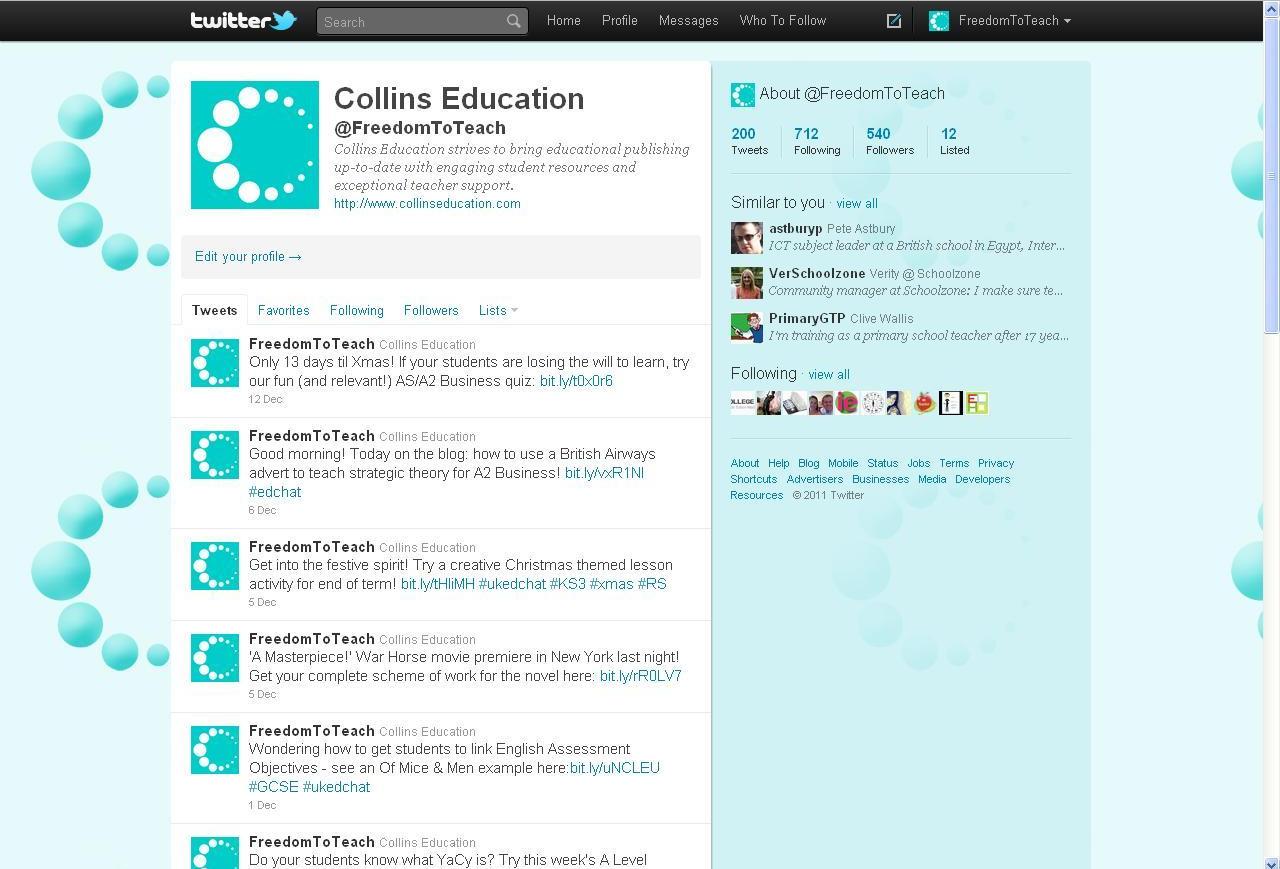
The idea of using microblogging and social networking in the classroom seems strange, but by leveraging Twitter as a tool for teaching Business and Economics (though these tips apply for almost every subject) you can really inspire some fantastic discussions and take advantage of real time economic data.

Collins Education's twitter page @freedomtoteach
I recently set up an account and have used it in a number of different ways. These have included collaborative home study discussions on economic opportunities for the BRICS and the online issue of web links for reference prior to a lesson. Twitter is also an excellent tool for getting students to sum up an article or case study in no more than 140 letters or simply just to put the BBC and Guardian emerging business news at their fingertips. If your school has not banned Twitter from its network, then it is fantastic as a collaboration tool.
Professionally, it’s an excellent sounding board for discussing topics with prominent economists or business professionals. Many of my lesson plan ideas have come from discussions and simple conversations. I have often been able to work these ideas into the scheme of work for the department to make it that little more interesting.  Some ideas, thoughts, articles can be found in this PDF.

Another excellent resource that I have been using recently is the Prezi presentation software available at http://prezi.com/. PowerPoint can be incredibly boring for students, but this software really allows you to develop a good looking and intuitive presentation that builds in links and video incredibly easy. Its also another great collaborative tool for students should your school purchase the Enjoy or Pro versions. It’s IWB friendly, non-linear and above all interesting. I have been continually developing one Prezi on the ‘Rise of China’ and have integrated data, images and video that I have actually sourced from Twitter.

Take a look at this completed presentation here by Andrew McCarthy:
http://prezi.com/-b1mqqi3ayqw/introduction-to-development-economics/

In addition a great example of why using Prezi in the classroom can be beneficial through Paul Hills Prezi:
http://prezi.com/rfsnedhqmhqa/thoughts-on-using-prezi-as-a-teaching-tool/

Daniel Baker
Business and Economics Department, Trinity Catholic High School

Monday, 12 December 2011

Secondary Business - News Quiz 12/12/11

Any student sitting the AQA Unit 4 exam in January will know the need to understand what is happening in the current business environment; use these quizzes as a revision tool and as discussion points for your students.

For example, the question on South Korean interest rates at 3.25% - you could ask students to compare this rate to that of the UK at 0.5% or even America  at 0.25%, this could give a good compare and contrast point. The question will also allow you to discuss what is currently happening with the Eurozone crisis and the wider affect it has on countries around the world.

Another good question to discuss would be, considering the dominance of Apple & Google Android in the download market, Google and its Android system are very quickly catching up with Apple, why is this, what competitive advantage do they have? You could also apply Porter’s % forces here to look at the level of competition in this market.

Here is the latest ‘Business News Quiz’. Download the Word version (with answers) to print off and use with your classes here!


  1. Apple announced in July that 15 billion app’s had been downloaded from their store how many have been downloaded from Google's Android Market?
    5 billion ( )
    10 billion( )
    20 billion ( )
    15billion ( )

  2. Tesco said it is seeing the impact on consumers of rising unemployment and rising living costs, by how much have sales at Tesco's UK stores fallen in recent weeks?
    1.5%( )
    0.5 %( )
    1.3%( )
    0.9%( )

  3. US banking giant, Citigroup, has said it is to cut how many jobs around the world in an effort to reduce its costs?
    1500 ( )  
    2500 ( )
    4500 ( )
    3000 ( )

  4. Australia's economy grew more than expected in the third quarter, at 2.5% what is it claimed is the reason for this growth?
    Tourism ( )
    Increased retail spending( )
    Building and mining ( )
    The hot weather( )

  5. Central banks in New Zealand and South Korea have kept interest rates on hold, citing fears of the impact of the debt crisis in Europe.New Zealand kept rates unchanged at 2.5%, while South Korea held its cost of borrowing at what level?
    1.25% ( )
    3.25%( )
    0.25%( )
    2.5% ( )

  6. A series of private pictures of Facebook founder Mark Zuckerberg have been posted online by "hackers" to highlight a bug in the social network, how many users does Facebook have?
    950 million( )
    750 million ( )
    650 million ( )
    850 million ( )

  7. Food giant Kraft Foods is to cut 200 jobs despite planning to spend £50m on chocolate and biscuit manufacturing, which UK Company did they buy in 2010?
    Cadbury ( )
    Innocent ( )
    Morrison’s ( )
    Arla Foods( )

  8. Who is the last girl left in The Young Apprentice final this year?
    Haya Al Dlame ( )
    Zara Brownless ( )
    Hayley Forrester ( )
    GbemiOkunlola( )

  9. Economic growth in the UK "remains subdued" and output will not reach 2008 levels until what year? The National Institute for Economic and Social Research (NIESR) has said.
    2012 ( )
    2013 ( )
    2014( )
    2015( )

  10. Basic bank account holders at which bank could face more frequent charges of up to £28 a day, if they fail to have sufficient funds in their accounts?
    Barclays ( )
    HSBC ( )
    Natwest ( )
    Santander( ) 
Donna Jestin
Teacher of Business Studies Notre Dame College & Senior Examiner for AQA

Wednesday, 7 December 2011

Secondary ICT - The Importance of Freedom

When setting assessment tasks there are many criteria to consider. Certainly the most important is the relationship between the assessment task and the specification of the course. This, set by the examination board, is central to our thinking, but there are of course many other criteria which we have to bear in mind.  Can the task be tackled? Are the students ready for the assessment and are the resources available, notably time being one of these?

Perhaps we need to recognise our differences
I wonder if we sufficiently rate freedom. What I have in mind is both freedom of expression in an aesthetic sense, but also freedom to develop academically, to be able as a student to try to push out from the cosy set of skills and ideas into something new. If we are to value this type of approach then we have to accept the risk that the final “product” may be handicapped by unrealisable dreams.  Students are young and, when motivated, often want to produce software solutions well beyond of what they are capable. Ah, the idealism of youth! How risky it is for us, how much safer and assessable it feels to prescribe the tasks and hope that the moderator misses signs that the “cookbook” has been used.

It’s pretty obvious though isn’t it; just consider the moderator’s view for a moment. He or she will have seen not just our school’s offerings, but those of another half dozen or so schools this year and for an experienced moderator many more than this. Won’t it be plain that the scenarios used are the same? No problem with that, but if the solutions to the problems set by the scenario are all very similar, here’s the problem. If the solutions look the same on paper or electronically, then it’s going to be difficult to discriminate between work submitted by the students. Even more difficulty will be found in proving values ascribed to the work.

How do we get round the problem? We could rely on nuances between the students’ work such as better layout, better font size, better design of GUI, but do we feel this really reflects the differences that we know there are between the students over the last two years?

There is another side to this and it relates to the students’ responsibility for their own learning, a respected aim of the National Curriculum no less! Just as a practical issue, this must be worth considering: ministering to every need of everyone in the class is an impossible task and cannot be expected to deliver high quality aid for each of the students. Taking control of an ICT project is not the same as accepting responsibility for one’s own education, but it surely is part of the culture. Whose project is it?  If it’s yours teacher, then you can do it; or if I have to, then the brain is elsewhere – it doesn’t come with this package, sorry.

John Giles
John has taught in various secondary schools for over 30 years, including roles as ICT coordinator and Head of ICT. He is also an established author and has worked as an examiner and moderator for a number of exam boards.

Secondary History - Taking a Second Look

Sometimes you know a topic really well, you’ve taught it many times, you are familiar with the key ideas and subject knowledge. You know which text book has the best images, the best activities, or which clip of film to show to engage your students. But sometimes, going back to original documents can make you – and your students – see a topic in a different light.
Take for instance, this extract from a monthly report from Leicester, November 1940:

‘We fed 100 men with a hot meal at an hour’s notice one day, and the next day 30 turned up without any warning...
...During the fortnight 17th to 30th [November] we served over 268,800 cups of tea and have used over 6 cwt of tea, (305 kilos) 15 cwt of sugar, (762 kilos) 270 lbs margarine, (122 kilos) 351 x 3lb (1.4 kilos) slabs of cake and [more than] 300  loaves. Buying this has been a very difficult problem, especially tinned milk. We are still very short of tinned milk... The food office have helped us all they could and granted us extra permits for sugar and margarine, and also released three whole cheeses for us. The bakers came to an end of their fruit ration, so we got a case of currants and sultanas and these they made into cakes...’
[Women’s Voluntary Services for Civil Defence Leicester report for the month of November 1940]

We are all familiar with the image of a canteen van after an air raid, serving tea. But how long would it take to make 268,000 cups of tea, or to drink it? In a time of rationing how on earth do you get hold of 6 cwt of tea, or 15 cwt of sugar? Or serve dinner for 100 men at one hour’s notice? What impression does it give you of the Women’s Voluntary Service, and the volunteers providing this service? By going back to original sources like this you do get a different perspective, and a clearer understanding, of the difficulties of ordinary everyday life on the Home Front during World War Two.

You can find lots more original sources about the Home Front during WW2 – and activities to go with them for Key Stage 2 and Key Stage 3 – on the website ‘The Army That Hitler Forgot’ at www.wrvs.org.uk/schools

Alf Wilkinson
CPD Manager for the Historical Association and previously National Strategist for Key Stage 3 History. Alf has over 30 years history teaching experience and was lead author for Collins Key Stage 3 History resources.