At the risk of throwing the whole curriculum into disarray I’m a firm believer in being aware of anniversaries of the people and events that have shaped the nation or the world. Not for me the rigid sticking to textbooks and schemes of work and thankfully my head teacher agrees. The change of government and the declaration that the National Curriculum was once again king rather than the QCA Schemes of Work, threw some members of the teaching profession into a tailspin. Thankfully the instruction wasn’t to consign QCA to the dustbin of history but to rely on it less heavily in favour of covering the required attainment targets by whatever creative means the teacher chose to employ. This year we have several opportunities to use national events to supplement and indeed enhance the curriculum whilst making children aware of how the world today was shaped. We have the Queen’s diamond jubilee, the bicentenary of the birth of Charles Dickens, the Olympics and the 100th anniversary of the Titanic.
The 15th of April this year sees the centenary of the sinking of the RMS Titanic, probably the world’s most famous ship and immortalised in James Cameron’s film Titanic, one of the top grossing films of all time. Whilst a tragic event that will never be forgotten, the story makes an interesting topic to cover in schools, mostly because many children are familiar with it. I can remember working with a Year 2 class on the topic and they were amazed when listening to the story and the work they produced was some of the best they’d carried out that year.
As the anniversary approaches, events will be held around the country, at the dockyard in Belfast where the ship was constructed, at the port it first sailed from, Southampton, which already has several artefacts and memorials to the tragic event, and in its home city of Liverpool.
Most schools that use the story in the curriculum focus on the literacy that can be gained from it; writing letters to loved ones in the hope they’ll be found after the ship sinks or telling friends about the enormity and the facilities of the ship prior to its sailing.
You can expand the topic substantially without stretching credulity and in the accompanying activities we’ve tried to show you how you can spend up to a week of the curriculum around the time of the anniversary using the Titanic in different ways. You just know that with the national interest in the topic, the kids in your class are going to be asking questions and with our help, you’ll enable them to find out many of the answers.
Dave Lewis
Primary teacher

Thursday, 15 March 2012

Tuesday, 13 March 2012
X raying Crystals
In 1912, Max von Laue had an idea for an experiment that would answer a question in physics. The results inspired scientists to make discoveries that have influenced chemistry and biology and provide evidence for many of the principles taught at GCSE and A level.
X rays were discovered by Wilhelm Rontgen in 1895 but physicists could not agree on whether they were particles (like alpha and beta rays) or waves (like light). If they were a form of light they must have wavelengths less than a nanometre. Max von Laue was teaching at the University of Munich in 1912 when he had his big idea.
Von Laue knew that the distance between atoms in a crystal was less than a nanometre. Diffraction happens when waves pass through narrow gaps and form a distinctive pattern. Von Laue predicted that the gaps between the rows of atoms in a crystal should produce a diffraction pattern with X rays. Two of his students, Friedrich and Kipping, tried out the experiment. They put a copper sulfate crystal surrounded by a sheet of photographic paper in a lead box and shone a narrow beam of X rays at it. A very complicated pattern was formed so they tried zinc sulfide instead. This gave a simple, regular pattern of spots. Von Laue’s method worked and proved that X rays were waves. Von Laue won the Nobel Prize in 1914 but that was just the start of the story of X ray crystallography.
As soon as von Laue published the results of his idea in 1912, the father and son team of W.H. Bragg and W.L.Bragg realised that not only was it a means of investigating X rays it was a method for exploring crystals. The Braggs worked out the mathematical formula for analysing the diffraction patterns and set to work. The method was very difficult because the crystals had to be quite large and perfectly formed but soon they had discovered the pattern of carbon atoms in diamond and the structure of sodium chloride.
At the time, most chemists thought that sodium chloride was made up of molecules of a sodium atom joined to a chlorine atom. The Braggs showed that in fact it consisted of sodium ions surrounded by six chloride ions, and vice versa, arranged in a cube. There were no molecules with the formula NaCl. Their discoveries transformed chemists’ ideas about the importance of the structure of substances and the bonds between atoms. The Braggs were awarded the Nobel Prize in 1915. In the 1920s Linus Pauling used results from X ray crystallography to develop the ideas about ionic and covalent bonding taught in GCSE and A level chemistry today.
In 1924, while at the Royal Institution in London with W H Bragg, a young scientist, John Bernal worked out the arrangement of carbon atoms in graphite. He also realised that X ray crystallography would be useful to find the structure of organic compounds. In 1929, Bernal’s student, Kathleen Lonsdale, proved that benzene was a flat hexagonal molecule. Lonsdale was a Quaker who went to prison in 1943 for refusing to do war work but in 1945 she became the first woman to be made a Fellow of the Royal Society.
X ray crystallography attracted a number of female scientists. Bernal built up a team at the University of Cambridge. They studied the patterns produced by crystals of vitamins and viruses. Dorothy Hodgkin studied with Bernal in 1934 before setting up her own X ray unit at the University of Oxford. She worked with large biological molecules. In 1949 she worked out the structure of penicillin, just as it was becoming famous as an antibiotic. In 1956 she found the structure of vitamin B12 for which she won the Nobel Prize in 1964, and in 1969, after thirty years’ work, she completed the structure of insulin. It had taken so long because thousands and thousands of calculations were needed for each structure. Computers can now do in minutes what used to take years and many thousands of complex molecules have had their structure worked out using X ray crystallography.
Back in 1953 however, Rosalind Franklin did not have the use of a computer. Kings College, London had given her the task of collecting X ray pictures of DNA. DNA was very difficult to crystallise but Franklin succeeded and produced patterns that convinced Crick and Watson that DNA has a double helix shape. They leapt to the structure with model building while Franklin worked towards the same answer by doing the long-winded calculations. It was her work that confirmed Crick’s and Watson’s insight.
Activities
1 Explore the lives of the scientists mentioned in the articles – Max von Laue, W.H and W.L Bragg, J.D. Bernal, Kathleen Lonsdale, Dorothy Hodgkin, Rosalind Franklin.
2 Find out the arrangement of the atoms or ions in diamond, graphite, sodium chloride, benzene and zinc sulfide.
3 Why do you think the X ray diffraction pattern of copper sulfate crystals (CuSO4.5H2O) proved to be more complicated than that of zinc sulfide (ZnS)?
4 Why is it important to know the structure of biological molecules such as insulin?
5 Why do you think that many of the early X ray crystallographers were women?
6 Discuss whether biology, chemistry and physics should be treated as separate subjects or as one subject – science.
X rays were discovered by Wilhelm Rontgen in 1895 but physicists could not agree on whether they were particles (like alpha and beta rays) or waves (like light). If they were a form of light they must have wavelengths less than a nanometre. Max von Laue was teaching at the University of Munich in 1912 when he had his big idea.
Von Laue knew that the distance between atoms in a crystal was less than a nanometre. Diffraction happens when waves pass through narrow gaps and form a distinctive pattern. Von Laue predicted that the gaps between the rows of atoms in a crystal should produce a diffraction pattern with X rays. Two of his students, Friedrich and Kipping, tried out the experiment. They put a copper sulfate crystal surrounded by a sheet of photographic paper in a lead box and shone a narrow beam of X rays at it. A very complicated pattern was formed so they tried zinc sulfide instead. This gave a simple, regular pattern of spots. Von Laue’s method worked and proved that X rays were waves. Von Laue won the Nobel Prize in 1914 but that was just the start of the story of X ray crystallography.
As soon as von Laue published the results of his idea in 1912, the father and son team of W.H. Bragg and W.L.Bragg realised that not only was it a means of investigating X rays it was a method for exploring crystals. The Braggs worked out the mathematical formula for analysing the diffraction patterns and set to work. The method was very difficult because the crystals had to be quite large and perfectly formed but soon they had discovered the pattern of carbon atoms in diamond and the structure of sodium chloride.
At the time, most chemists thought that sodium chloride was made up of molecules of a sodium atom joined to a chlorine atom. The Braggs showed that in fact it consisted of sodium ions surrounded by six chloride ions, and vice versa, arranged in a cube. There were no molecules with the formula NaCl. Their discoveries transformed chemists’ ideas about the importance of the structure of substances and the bonds between atoms. The Braggs were awarded the Nobel Prize in 1915. In the 1920s Linus Pauling used results from X ray crystallography to develop the ideas about ionic and covalent bonding taught in GCSE and A level chemistry today.
In 1924, while at the Royal Institution in London with W H Bragg, a young scientist, John Bernal worked out the arrangement of carbon atoms in graphite. He also realised that X ray crystallography would be useful to find the structure of organic compounds. In 1929, Bernal’s student, Kathleen Lonsdale, proved that benzene was a flat hexagonal molecule. Lonsdale was a Quaker who went to prison in 1943 for refusing to do war work but in 1945 she became the first woman to be made a Fellow of the Royal Society.
X ray crystallography attracted a number of female scientists. Bernal built up a team at the University of Cambridge. They studied the patterns produced by crystals of vitamins and viruses. Dorothy Hodgkin studied with Bernal in 1934 before setting up her own X ray unit at the University of Oxford. She worked with large biological molecules. In 1949 she worked out the structure of penicillin, just as it was becoming famous as an antibiotic. In 1956 she found the structure of vitamin B12 for which she won the Nobel Prize in 1964, and in 1969, after thirty years’ work, she completed the structure of insulin. It had taken so long because thousands and thousands of calculations were needed for each structure. Computers can now do in minutes what used to take years and many thousands of complex molecules have had their structure worked out using X ray crystallography.
Back in 1953 however, Rosalind Franklin did not have the use of a computer. Kings College, London had given her the task of collecting X ray pictures of DNA. DNA was very difficult to crystallise but Franklin succeeded and produced patterns that convinced Crick and Watson that DNA has a double helix shape. They leapt to the structure with model building while Franklin worked towards the same answer by doing the long-winded calculations. It was her work that confirmed Crick’s and Watson’s insight.
Activities
1 Explore the lives of the scientists mentioned in the articles – Max von Laue, W.H and W.L Bragg, J.D. Bernal, Kathleen Lonsdale, Dorothy Hodgkin, Rosalind Franklin.
2 Find out the arrangement of the atoms or ions in diamond, graphite, sodium chloride, benzene and zinc sulfide.
3 Why do you think the X ray diffraction pattern of copper sulfate crystals (CuSO4.5H2O) proved to be more complicated than that of zinc sulfide (ZnS)?
4 Why is it important to know the structure of biological molecules such as insulin?
5 Why do you think that many of the early X ray crystallographers were women?
6 Discuss whether biology, chemistry and physics should be treated as separate subjects or as one subject – science.
Monday, 12 March 2012
Secondary History - Reinforcing chronological understanding
Students often find it difficult to sequence events or people, yet it is crucial to understanding cause and effect, continuity and change, and most other things in history. Here are a couple of well-tried and tested ways to reinforce chronology.
Let’s start with a pillar box:

Let’s start with a pillar box:

Why is it green? When was it made? Who installed it? Where was it made?
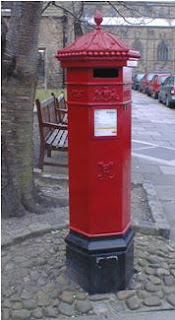
Nearly all of these questions can be answered from a close examination of the pillar box. It is green because it is in the Republic of Ireland, and was originally red, installed in the reign of Edward VII.
Now, how about these pillar boxes?
Can you put these pillar boxes in chronological order?
1.
2.
3.
4.

5.
Each pillar box has the cipher of the monarch on it, so VR dates from Queen Victoria’s reign, and so on. Which monarch is missing from the above collection? In ‘Powerpoint’ in ‘outline’ mode it is easy to manipulate images around a page. Of course it is even easier with an Interactive White Board if you have one. This activity can be endlessly recycled using houses, modes of transport, inventions, battles, political leaders, whatever is appropriate. Used regularly as a starter activity it helps build up a sense of chronology and of linking events together.
Of course you can do this activity on paper too, as a card sort or, if you want to involve the whole class, using the Washing Line Game. Write 20 or so names, events, etc, on to individual sheets of paper, and hand them out to your class, one to each student. One at a time get them to come out to the front of the class and put their event in the right place standing along a timeline, or peg it onto a string stretched across the classroom. Get the rest of the class to ascertain whether or not the event is in the correct place. It gets very noisy, but it is very effective at reinforcing chronological understanding!
Alf Wilkinson
CPD Manager for the Historical Association and previously National Strategist for Key Stage 3 History. Alf has over 30 years history teaching experience and was lead author for Collins Key Stage 3 History resources.
Thursday, 8 March 2012
Secondary Business - News Quiz 08/03/12
Here is this week's Business News Quiz! You can print off a Word version (with answers and weblinks) and use it with your classes.
You can download the Word file here.
You can download the Word file here.
- Which sportswear firm has unveiled its best-ever annual profits with a rise of 18% in net profit, as hopes rise that this year's Olympics will help it break more records?
Reebok ( )
Sweaty Betty ( )
Nike ( )
Adidas ( )
- The average price of unleaded petrol has hit a record high, according to government figures, how much is the average for a litre of petrol?
147.3 pence ( )
137.3 pence ( )
127.3 pence ( )
117.3 pence ( )
- Sony says a number of which artist's tracks have been stolen after its website was hacked?
Amy Winehouse ( )
Michael Jackson ( )
Rihanna ( )
Madonna ( )
- Tokyo prosecutors have charged which camera-maker and three of its former executives in connection with a $1.7bn (£1bn) accounting cover-up?
Nikon ( )
Cannon ( )
Olympus ( )
Kodak ( )
- Which US investment bank that collapsed in 2008, has exited from bankruptcy protection?
Fannie Mae ( )
Lehman Brothers ( )
Bear Sterns ( )
Merrill Lynch ( )
- Which supermarket says the emergence of what it calls "professional shoppers" has helped it to lift full year profits?
Waitrose ( )
Morrisons ( )
ASDA ( )
Sainsburys ( )
- Which car firm has recalled 681,500 vehicles in the US dealing a blow to its efforts to rebuild its image after a number of safety issues in recent years?
Vauxhall ( )
Toyota ( )
Ford ( )
BMW ( )
- Which department store has reported a fall in annual profits and cut its staff bonus for the first time in three years?
Debenhams ( )
House of Fraser ( )
John Lewis ( )
Selfridges ( )
- An Aberdeenshire student has said she was shocked to find her image on children's clothing being sold by who, after she hadn’t given permission?
Topshop ( )
Primark ( )
Tesco ( )
H&M ( )
- A Mexican tycoon has once again come top of Forbes magazine's annual list of the world's richest billionaires, who is he?
Bernard Arnault ( )
Li Ka-Shing ( )
Larry Ellison ( )
Carlos Slim ( )
Donna Jestin
Teacher of Business Studies Notre Dame College & Senior Examiner for AQA
Monday, 5 March 2012
Secondary English - Building Learning Power
Sometimes you need to make sure your class knows a deluge of information; this might be before an exam, before you start a topic or midway through to check understanding. As we are told again and again, simply ‘telling’ your pupils means they retain very little of the information, ‘doing’ increases their ‘Learning Power’ and allows them to remember the information due to the way it was taught.
With this in mind, ‘Building Learning Power’ lessons work really well and create a lively learning atmosphere in your room. These lessons also engage all learners, use group work and work especially well with classes where pupils have issues sitting still!
How it works
Before the pupils enter the room, set up a couple of tables in an area that has a lot of room. Station yourself at these tables with a timer or have the timer running on your interactive white board. On the tables place your ‘fact sheets’ face down, make sure you have enough for one between two for each group. (See my example for the novel ‘Of Mice and Men’)
Put pupils into groups of 4, 2 ‘runners’ and 2 ‘writers’. Each table should have one blank grid sheet. (Download an example grid here)
Your ‘runners’ have one minute to get to the table and memorise as much as they can from their fact sheet. After the minute they put the fact sheet back face down and return to their ‘writers’ who need to record the right information into the right box. This is repeated around 10 times, depending on how your group is progressing. What I love about this activity is that most of the groups will come up with a strategy, some memorise different areas of the sheet and others make up rhymes for key events or mouth the words over and over.
After the activity is over you can give groups a mark out of 5 (1 for each box) for the information they retained. It is also worth doing a plenary that involves the groups having to put their sheets under their chairs and asking them questions from the fact sheets to test how much they can remember. I always back this up with a similar style starter for next lesson to ensure the information is really wedged in there! The resources can be tailor made for any event, I’ve used them for Media lessons when pupils need to learn a lot of terminology as well as A Level lessons where pupils need to memorise poems.
Joanna Fliski
Teacher of English, Media and Drama, Lliswerry High School
With this in mind, ‘Building Learning Power’ lessons work really well and create a lively learning atmosphere in your room. These lessons also engage all learners, use group work and work especially well with classes where pupils have issues sitting still!
How it works
Before the pupils enter the room, set up a couple of tables in an area that has a lot of room. Station yourself at these tables with a timer or have the timer running on your interactive white board. On the tables place your ‘fact sheets’ face down, make sure you have enough for one between two for each group. (See my example for the novel ‘Of Mice and Men’)
Put pupils into groups of 4, 2 ‘runners’ and 2 ‘writers’. Each table should have one blank grid sheet. (Download an example grid here)
Your ‘runners’ have one minute to get to the table and memorise as much as they can from their fact sheet. After the minute they put the fact sheet back face down and return to their ‘writers’ who need to record the right information into the right box. This is repeated around 10 times, depending on how your group is progressing. What I love about this activity is that most of the groups will come up with a strategy, some memorise different areas of the sheet and others make up rhymes for key events or mouth the words over and over.
After the activity is over you can give groups a mark out of 5 (1 for each box) for the information they retained. It is also worth doing a plenary that involves the groups having to put their sheets under their chairs and asking them questions from the fact sheets to test how much they can remember. I always back this up with a similar style starter for next lesson to ensure the information is really wedged in there! The resources can be tailor made for any event, I’ve used them for Media lessons when pupils need to learn a lot of terminology as well as A Level lessons where pupils need to memorise poems.
Joanna Fliski
Teacher of English, Media and Drama, Lliswerry High School
Friday, 2 March 2012
Secondary Citizenship - Whose human rights?
The release of Abu Qatada has led to headlines designed to convince newspaper readers that human rights should not be promoted or defended. This raises plenty of issues for Citizenship lessons. They range from the need for world agreements on human rights to actions of the European Court of Human Rights in Strasbourg and the way the British legal system operates.
Any of the articles in the popular press provide opportunities for students to distinguish between fact and opinion. An easy example, if students need to be introduced to the idea, would be ‘Best friend claimed Qatada came to London to enjoy free speech - and NOT because he was fleeing torture’
The following link takes you such an article:
http://www.dailymail.co.uk/news/article-2101283/Abu-Qatada-Wembley-Hate-preacher-freed-live-near-prime-terror-target.html
The lessons that you might teach about this issue will vary from year group to year group. It’s very emotive so it would be wise to stick to simpler issues with younger students so using it as a starter for human rights would be interesting. The European Court refused permission to deport him to Jordan because if he was put on trial, the evidence used might have resulted from torture. Students readily follow the basic human rights of housing, food and education but it is useful to have examples of ones which, thankfully, are less familiar.
Older students might be asked to explore the issue to find out what lies behind the headlines. Abu Qatada had been imprisoned for seven years without trial. Is this right? Why was he held for so long without being brought to court?
Liberty, the pressure group which aims to protect civil liberties and promote human rights, has a website which explains its campaigns and views on current issues. It believes that Abu Qatada should be tried in Britain and questions why this hasn’t happened.
http://www.liberty-human-rights.org.uk/news/2012/abu-qatada-the-unanswered-questions.php
Liberty has a great website to use when exploring human rights. The organisation ran a competition for schools last year. Students were asked to write a short piece of poetry or prose inspired by any or all of the Articles within the Human Rights Act and the winners came from schools across the country. Keep an eye open for future competitions.
If you want to keep up with ongoing human rights issues, Liberty’s blog is a useful tool and they have plenty of resources for schools.
http://www.liberty-human-rights.org.uk/news/index.php
Jenny Wales is author of Citizenship Today for GCSE, published by Collins.
Any of the articles in the popular press provide opportunities for students to distinguish between fact and opinion. An easy example, if students need to be introduced to the idea, would be ‘Best friend claimed Qatada came to London to enjoy free speech - and NOT because he was fleeing torture’
The following link takes you such an article:
http://www.dailymail.co.uk/news/article-2101283/Abu-Qatada-Wembley-Hate-preacher-freed-live-near-prime-terror-target.html
The lessons that you might teach about this issue will vary from year group to year group. It’s very emotive so it would be wise to stick to simpler issues with younger students so using it as a starter for human rights would be interesting. The European Court refused permission to deport him to Jordan because if he was put on trial, the evidence used might have resulted from torture. Students readily follow the basic human rights of housing, food and education but it is useful to have examples of ones which, thankfully, are less familiar.
Older students might be asked to explore the issue to find out what lies behind the headlines. Abu Qatada had been imprisoned for seven years without trial. Is this right? Why was he held for so long without being brought to court?
Liberty, the pressure group which aims to protect civil liberties and promote human rights, has a website which explains its campaigns and views on current issues. It believes that Abu Qatada should be tried in Britain and questions why this hasn’t happened.
http://www.liberty-human-rights.org.uk/news/2012/abu-qatada-the-unanswered-questions.php
Liberty has a great website to use when exploring human rights. The organisation ran a competition for schools last year. Students were asked to write a short piece of poetry or prose inspired by any or all of the Articles within the Human Rights Act and the winners came from schools across the country. Keep an eye open for future competitions.
If you want to keep up with ongoing human rights issues, Liberty’s blog is a useful tool and they have plenty of resources for schools.
http://www.liberty-human-rights.org.uk/news/index.php
Jenny Wales is author of Citizenship Today for GCSE, published by Collins.
Thursday, 1 March 2012
Secondary Business - News Quiz 01/03/12
Here is this week's Business News Quiz! You can print off a Word version (with answers and weblinks) and use it with your classes.
You can download the Word file here.
You can download the Word file here.
- Which banks annual profits rose 15% to £13.8bn ($21.9bn) in what it called a year of "major progress"?
Santander ( )
HSBC ( )
HBOS ( )
Lloyds TSB ( )
- Which business' profits have been boosted 14% due to Downtown Abby and The X factor?
Sky ( )
Pizza Hut ( )
Domino’s ( )
ITV ( )
- ECB has provided further 530bn euros ($713bn; £448bn) of low-interest loans to 800 banks, who is the ECB?
Eastern Committee Bank ( )
European Central Bank ( )
European Committee of Businesses ( )
European Central Business ( )
- Northern Rock is expected to return a profit of up to £11bn to the taxpayer over the next 10 to 15 years, the body which manages the government's bank investments has said. What is Northern Rock soon to be known as?
Virgin Bank ( )
The Governments Bank ( )
Virgin Money ( )
The new Northern Rock ( )
- The Raspberry Pi went on general sale on February 29th 2012, what is it?
A bare-bones computer ( )
A new exotic raspberry mouse ( )
Raspberry coloured mobile phone ( )
The largest raspberry ever found and sold by Tesco in the UK ( )
- Apple has announced an event on 7 March at which the company is expected to launch its latest what?
iPhone 5 ( )
new iPod nano ( )
iPad 3 ( )
new iPod touch ( )
- Who has stepped down as executive chairman of News International, the UK newspaper business that owns The Sun and The Times titles?
James Murdoch ( )
Rupert Murdoch ( )
Simon Cowell ( )
Rebekah Brooks ( )
- Whose stock market value closed above $500bn (£314bn) this week, cementing its position as the world's most valuable company?
Exxon ( )
Microsoft ( )
Blackberry ( )
Apple ( )
- Shares dip for which airline as the carrier says it is in a "crisis" after reporting a loss for the last financial year?
British Airways ( )
Malaysia Airlines ( )
Singapore Airlines ( )
Virgin America ( )
- Microsoft has launched the preview edition of what new product/service?
Windows Phone ( )
Tablet computer ( )
Windows 8 ( )
Windows Store ( )
Donna Jestin
Teacher of Business Studies Notre Dame College & Senior Examiner for AQA
Subscribe to:
Posts (Atom)